
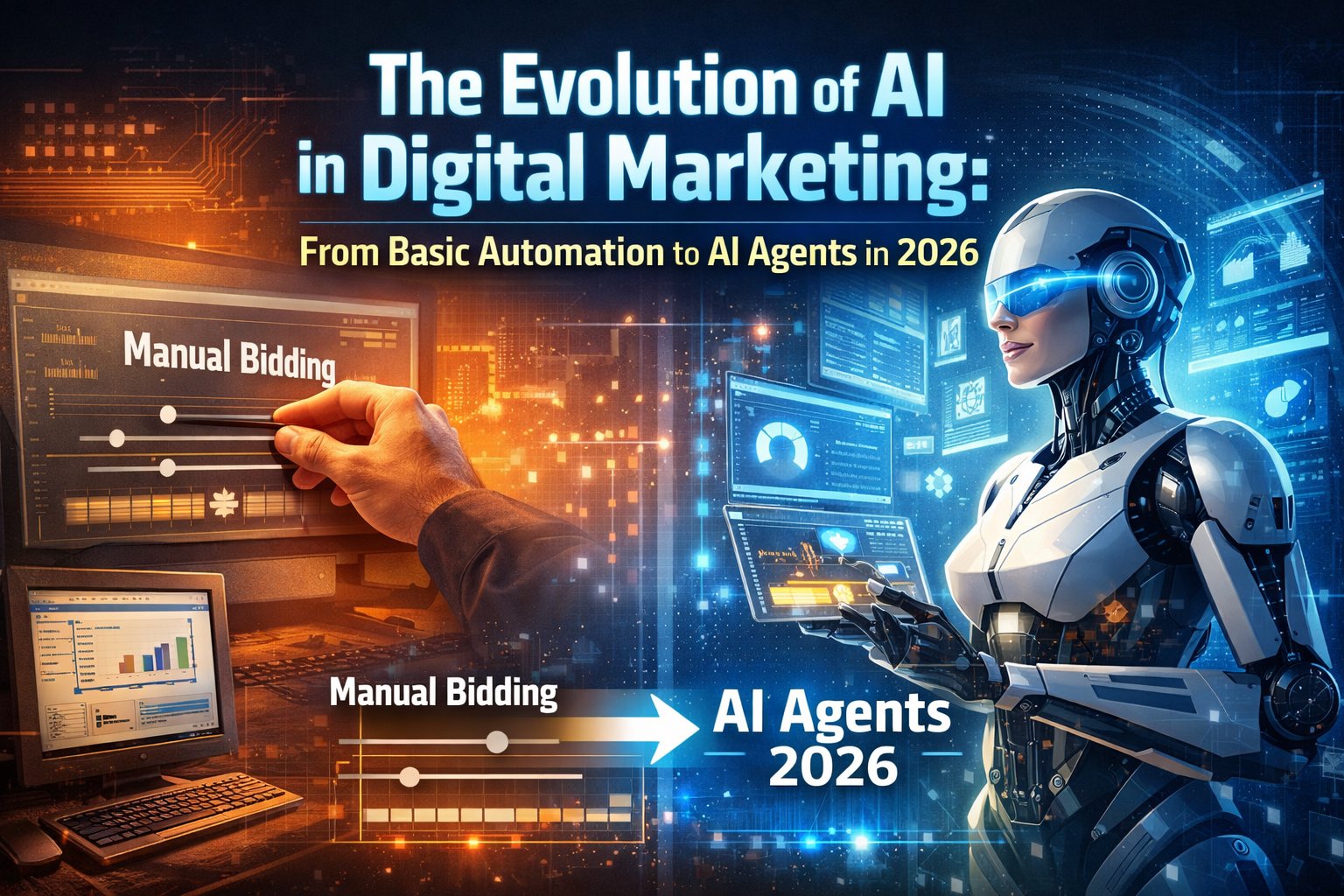




Digital marketing has always evolved alongside technology. But the last decade hasn’t just been an upgrade — it has been a transformation.
I still remember when campaign optimization meant sitting inside ad accounts for hours, manually adjusting bids, pausing keywords, testing ad copies one by one, and exporting Excel sheets to make performance decisions. Today, we feed signals into systems we can’t fully see — and AI makes decisions in milliseconds.
We moved from manual control to machine-led optimization.
From transparent levers… to what many now call “black box” AI models.
This is the evolution of AI in digital marketing — and where it’s heading in 2026.
Phase 1: The Era of Manual Optimization (2008–2015)
In the early days of performance marketing:
- Bidding was manual (CPC or CPM).
- Targeting was keyword-based or interest-based.
- Reports were basic and exported manually.
- A/B testing required constant human supervision.
Optimization was human-driven:
- Adjust bids every morning.
- Pause underperforming keywords.
- Split-test ad copies.
- Manually exclude placements.
Back then, expertise meant control.
The more you tweaked, the better you performed.
But as competition increased and platforms scaled, manual control became inefficient.
Phase 2: Rule-Based Automation (2015–2018)
This was the beginning of automation — but still predictable.
Platforms introduced:
- Automated rules (pause if CPA > X)
- Dayparting schedules
- Bid modifiers
- Basic smart bidding
Programmatic advertising expanded. Real-time bidding became standard.
The systems followed instructions.
If this → then that.
Marketers still controlled strategy. AI simply executed tasks faster.
Phase 3: Machine Learning & “Black Box” Optimization (2018–2023)
This was the turning point.
Platforms like:
- Google introduced Performance Max.
- Meta launched Advantage+ campaigns.
- Smart bidding became default.
Suddenly:
- You couldn’t see search terms clearly.
- Audience segmentation blurred.
- Placement transparency reduced.
- Budget allocation happened automatically.
The control panel shrank.
The algorithm expanded.
This is where many marketers felt uncomfortable.
We shifted from:
“I decide what to bid on.”
to
“I feed signals and trust the system.”
AI began optimizing:
- Audience discovery
- Creative combinations
- Bid adjustments
- Budget distribution
- Conversion prediction
Campaign management evolved into signal management.
Phase 4: AI-Driven Creative & Predictive Systems (2023–2025)
AI moved beyond bidding.
Now it generates:
- Ad copy variations
- Headlines
- Visual creatives
- Product descriptions
- Landing page drafts
Creative optimization became dynamic:
- Thousands of combinations tested automatically.
- Messaging adapted per audience.
- Predictive models forecasted conversion probability.
Marketing shifted from:
Campaign execution → Performance orchestration.
The marketer’s role became:
- Define objectives.
- Feed clean data.
- Guide strategic direction.
- Interpret results.
AI handled the mechanics.
Phase 5: The Rise of AI Agents in 2026
Now we are entering a new phase: AI Agents.
Unlike earlier automation, AI agents don’t just optimize inside a single platform.
They:
- Analyze cross-channel data.
- Adjust budgets across platforms.
- Generate creatives.
- Run experiments.
- Recommend strategic pivots.
- Detect anomalies automatically.
Instead of logging into five dashboards, marketers now supervise intelligent systems.
AI agents can:
- Launch campaigns based on performance triggers.
- Reallocate budget dynamically.
- Identify audience fatigue.
- Suggest new angles based on trend analysis.
This isn’t automation.
This is semi-autonomous marketing infrastructure.
What Changed in the Marketer’s Role?
Then:
- Tactical operator
- Manual optimizer
- Bid manager
Now:
- Strategic architect
- Data interpreter
- Signal engineer
- AI supervisor
The skillset has shifted from:
“How do I optimize this campaign?”
to
“How do I design the right system for AI to optimize?”
The “Black Box” Dilemma
AI models today are powerful — but opaque.
We don’t fully know:
- Why certain audiences are chosen.
- Why some placements perform better.
- Exactly how attribution is weighted.
This creates tension.
But here’s the truth:
AI is better at pattern recognition.
Humans are better at context and strategy.
The future is not AI vs marketers.
It’s AI + strategic oversight.
Risks of Over-Reliance on AI
As powerful as AI has become, there are real concerns:
- Over-automation reduces learning visibility.
- Weak tracking corrupts machine learning.
- Poor creative inputs lead to amplified inefficiency.
- Data privacy restrictions limit signal quality.
AI is only as strong as:
- The data it receives.
- The goals it’s assigned.
- The constraints it operates within.
Garbage in → optimized garbage out.
What Digital Marketers Must Learn in 2026
To stay relevant, professionals need to master:
1. First-Party Data Strategy
With cookie deprecation, signal quality is everything.
2. Conversion Architecture
Server-side tracking, enhanced conversions, data modeling.
3. AI Prompting & Creative Direction
Knowing how to guide AI creative systems effectively.
4. Strategic Budget Allocation
Cross-channel modeling instead of siloed management.
5. Critical Thinking
Questioning results instead of blindly trusting dashboards.
The Future: From Campaigns to Systems
We are moving toward a world where:
- Campaigns are always-on.
- Optimization is continuous.
- Creative testing is automated.
- Attribution is modeled.
- AI agents act in near real-time.
The competitive advantage will no longer be who clicks faster inside ad platforms.
It will be:
- Who designs better systems.
- Who feeds stronger signals.
- Who asks better strategic questions.
- Who understands both machine logic and human psychology.
Final Takeaway
The evolution of AI in digital marketing isn’t about losing control.
It’s about redefining control.
We began with manual bidding.
We moved to automation.
We entered black box machine learning.
Now we are stepping into AI agents.
The marketers who will win in 2026 are not the ones fighting automation.
They are the ones learning how to architect intelligence.

